
Strength Training After 50: The Step Most Women Skip
Have you noticed that strength training for women is being talked about and published everywhere? Your physician is now recommending it, your friends are starting to lift weights, and it's becoming the new conversation over lunch for women. I am seeing many more women entering the weight room at the gym, and social media is full of videos promising stronger arms, healthier bones, and more toned bodies. The research supports it too. Strength training is one of the best investments we can make for our physique, muscles, bones, balance, metabolism, and our ability to continue doing the things we love for years to come.¹
I know this world well. I started lifting weights at fourteen, in the boys' weight training room at Newbury Park High School in Southern California. I was the only girl in there, a freshman who had just made the boys' varsity tennis team in the early days of Title IX, when girls were still fighting for a place in spaces like that one. Nobody handed me a program built for a girl my age. I figured it out among the boys, and I caught the bug immediately.
Weight training was different in the 70s. Nobody was talking about form cues or corrective work. You just lifted, and you figured out the rest through trial and a fair amount of error. But something about that room changed me. I found a version of strength I didn't know I had, and I never left it.
I have never stopped believing that strength training is one of the best things a woman can do for her body and her life, and I want that for every woman reading this.
I also want to talk about something I have learned in my own body and my clients' bodies over the years. I have weight trained consistently for decades, and I never go without the fundamental exercises that keep my body strong and able to strength train without getting injured. Because at a certain point the body starts asking for more from us. As women, we reach an age where we can no longer simply show up and push hard without consequence. The body begins to need more preparation, more attention, more support before we load it. It's the price of longevity, and doing the prep work we are going to cover here is what allows us to keep training, keep moving, and keep doing the things that matter to us without getting hurt or ending up on the sidelines.
Which is exactly why I care so much about how women enter strength training. Getting you there is one thing. Keeping you there, healthy, consistent, and free from the injuries that pull so many women away, is what my work is really about.
So why do so many women become discouraged after they begin?
They join a gym, hire a trainer, or follow a workout online with the best of intentions. Then their shoulder starts talking to them, their knee doesn't like squats, their back tightens after a workout, and they begin to wonder if strength training just isn't for them. They needed a different starting point.
Are We Strengthening Patterns That Already Don't Work?
When I begin working with a new client, the first thing I want to understand is not how much she can lift or how fit she is. I want to know how her body has adapted to life over the decades she has been living in it.
Our bodies respond to everything we have asked them to do over the years. Sitting at a computer, repetitive movements, driving, carrying children or grandchildren on one hip, gardening, hiking, recovering from injuries, playing tennis or pickleball, even standing on one leg while cooking dinner all leave subtle fingerprints on the way we move. Most of these changes happen so gradually that they become our new normal, until one day the body reminds us they are there.
What I have observed over thirty years is that the body almost always finds a pathway to get the job done. If one hip loses some mobility, another area quietly contributes a little more. If your upper back doesn't move as well as it once did, your shoulder often works harder to compensate. These adjustments happen without us realizing it because the body is designed to keep us moving. The challenge is that those workarounds can eventually place more stress on joints and tissues that weren't designed to carry that load day after day, and when we add strength training on top of that, we end up loading the very areas that were already struggling or unstable.
Why Mobility and Stability Matter
This applies whether you are picking up a weight for the first time or have been strength training for years and find yourself working around the same shoulder, knee, or back issue every time you train.
Mobility gives your joints the available motion they need to move comfortably. Stability gives your body the control to use that motion well. My goal isn't to help someone become more flexible or stronger in isolation. It's to help mobility and stability work together so movement feels smoother, more efficient, and more comfortable before we start lifting weights or strength training.
Our body and mind are woven together as a dynamic working system and we want it to work as well as possible. When weak links or compensations develop, the system begins to find new pathways to accomplish the task. Over time those new pathways become more robust and essentially become the new normal. Here is what that looks like in real life: if you have a limitation in your shoulder and reach for something on a high shelf, your ribs may flare, your head drops to the opposite side, your back bends and rotates slightly, and your hip lifts to help you get there.
The more you move this way, the more that pathway between the mind and the body becomes reinforced and over time feels normal. But it places more tension and demand on surrounding areas to compensate, which over time can lead to pain or injury that seems completely unrelated to the original limitation. This is why I want to educate women about the right steps to take before jumping into the weight room. The good news is that we can change these pathways. With the right preparation, we can create or recreate efficient movement patterns that allow the body to work the way it was designed to.
Why This Matters More After 50
Women are not fragile over 50. They can become very strong and powerful, and I have watched that happen more times than I can count. Our bodies carry more history than they did at 30, and that history influences how we move today, but it does not define what we are capable of.
Hormonal changes also play a role. As estrogen declines during and after menopause, tendons and other connective tissues don't recover quite as easily as they once did. Research published in the Journal of Applied Physiology has shown that estrogen affects tendon collagen synthesis and structure, and when levels drop, the body's ability to repair everyday wear on connective tissue changes with it. That doesn't mean those tissues are weak. It means they respond better when we increase demands gradually instead of jumping ahead.²
In my experience, perimenopause and menopause are when women start noticing more bodily problems, more nagging issues that weren't there before, and that is precisely the moment to invest in the tissue and joint work that supports everything that comes after. We have to give back to the body at this point. This is the seed we plant before we grow.
None of these changes mean you shouldn't strength train. They reinforce why your starting point matters. I have watched women in their 60s, 70s, and 80s improve their balance, regain mobility, become stronger, and return to activities they thought they had left behind. The body continues to respond when we give it the right input and enough time.
What Building a Foundation Actually Looks Like
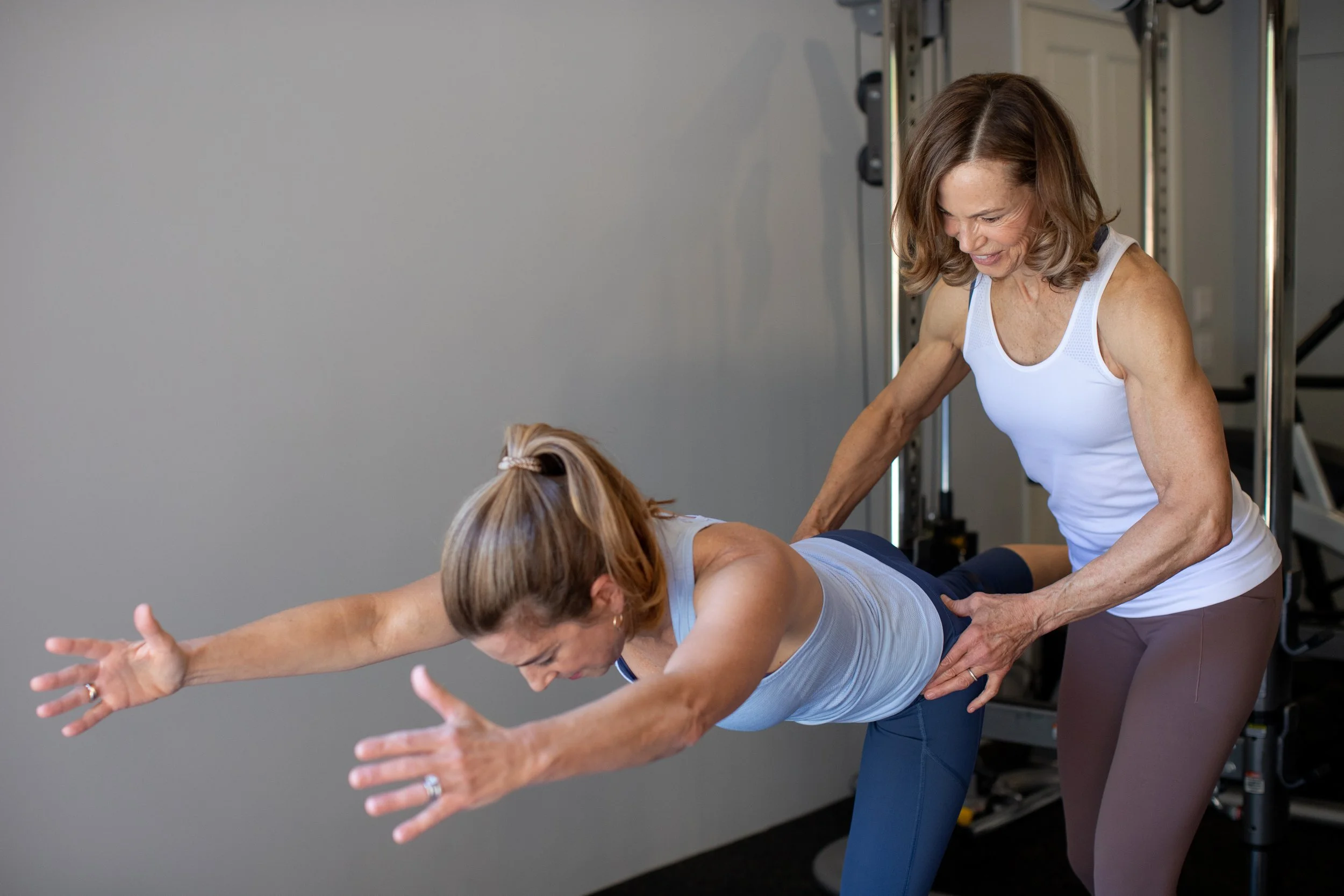
This is the same model I have designed for every one-on-one client I have worked with over thirty years, and it truly is what helps so many women thrive in their bodies.
Improve tissue quality. We begin by addressing areas of excessive tension using myofascial release techniques, foam rolling, or targeted ball work. Healthy tissue moves more freely and often responds better to the work that follows.
Restore mobility. Next, we improve the available motion at the joints that need it. Better mobility gives the body more options and often reduces the need for another area to work harder than it should.
Build stability. Once the body has motion, it needs control. Stability teaches the muscles surrounding the joints to support and guide movement with confidence, like the rotator cuff stabilizers controlling the shoulder. Research from a randomized controlled trial found that targeted stability training improved balance recovery and leg strength in older adults in as little as three to six weeks, which tells us the neuromuscular system responds more quickly than most people expect.
Refine movement patterns. Now we practice everyday movement. Squatting, hinging, pushing, pulling, bending, reaching, rotating, stepping, balancing, and walking all become opportunities to teach the body to distribute forces more efficiently.
Progressively build strength. Only then do we begin adding resistance. Strength training becomes more productive because the body is prepared to accept the load instead of fighting against it.
Don't let it overwhelm you. This process will allow you to get to know your body, connect, slow down, and breathe with each exercise. You will begin to love how you feel when tension and tightness release, movement becomes easier, and you notice your strength is improving.
Try This This Week
Before your next workout, become a curious observer of your body.
As you climb a flight of stairs, notice whether one leg always leads or feels like it's doing more of the work. As you reach into a high cupboard, notice whether you always reach with the same arm and if one shoulder moves more comfortably than the other. When you stand up from a chair, notice whether you naturally push with your hands or shift toward one leg. While brushing your teeth, stand on one leg for a few seconds and notice which side feels steadier. When sitting at your laptop, notice whether you cave in or lean more to one side of your torso.
Don't try to fix anything yet. Just become curious and start asking why. Try leading with the other leg on the stairs, reaching with the other arm into that cupboard, and notice how different or unfamiliar it feels. That feeling of unfamiliarity is your body telling you that it needs attention. This is where the work begins, and it doesn't take long before those unfamiliar movements start to feel more natural, more controlled, and more connected. That is when your body is telling you it's more balanced to lift weights.
Then We Lift
Once this foundation is in place, strength training becomes a genuinely different experience. You learn to squat by first understanding how your hips move and how to stabilize your spine and core. You learn to press by first restoring shoulder mobility and activating the small but important rotator cuff stabilizer muscles that support and protect the joint.
What I notice in women when they first begin lifting is that they are often a little nervous. They are quiet, wondering if their body is capable, whether it will hurt, whether they are doing it right. They are wondering if their bodies can execute the movement with weight in their hands. And then something shifts as they learn and practice. They begin to feel stronger. They feel more confident than they expected, and that feeling grows with every session.
Strength doesn't begin with the weight in your hands. It begins with how your body manages that weight.
What the foundation work gives women goes beyond physical preparation. They develop a different relationship with their bodies. They learn to identify where their tension and tightness lives, how to reduce it, how their muscles move their joints, and how the whole system works together. They don't just lift and wonder what the movement is doing for them. They understand it, and they know there is a direct purpose for each movement. They learn to love the way their bodies move, and because of that, they trust themselves more. They feel secure that they are executing the movements correctly and that their bodies are genuinely ready for the work.
Weight load is added gradually as the body adapts, not because we're being overly cautious, but because that's how strength is built with greater confidence and fewer setbacks.
For women who have been strength training for years, this applies equally. It's easy to get caught in the rhythm of hitting the gym hard, doing the same weight training routine, or not applying any progressive overload or new stimulus. For these women, the same foundation applies. Taking time to address the tissue quality, mobility, and stability work that supports your training can open up movement that has felt stuck for years, help you break through plateaus, and allow you to move through exercises that once caused discomfort with far greater ease.
A Different Way to Think About Getting Started
Starting with a movement foundation isn't a detour from strength training. It's the first chapter.
The women I've worked with over the years aren't trying to become elite athletes. They want to hike without thinking about their knees. They want to carry luggage through an airport, spend an afternoon gardening, lift a grandchild, explore a new city on foot, or say yes to an adventure without wondering whether their body will keep up.
That's why I care so much about where we begin. When your body moves well, strength training feels better. When strength training feels better, you're more likely to stay with it. And that's where the real benefits begin, not after one workout, but after years of consistently moving, lifting, and living in a body that feels capable.
If you're ready to build your foundation and take your first steps in strength training the right way, start with the free Video Sampler. It's five simple exercises, no equipment needed, and it will give you a real sense of how I teach and what this approach actually feels like in your body.
References
Westcott WL. Resistance training is medicine: effects of strength training on health. Current Sports Medicine Reports. 2012;11(4):209-216.
Hansen M, Kongsgaard M, Holm L, et al. Effect of estrogen on tendon collagen synthesis, tendon structural characteristics, and biomechanical properties in postmenopausal women. Journal of Applied Physiology. 2009;106(4):1385-1393.
Bohm S, Mandla-Liebsch M, Mersmann F, Arampatzis A. Exercise of dynamic stability in the presence of perturbations elicits fast improvements of simulated fall recovery and strength in older adults: a randomized controlled trial. Frontiers in Sports and Active Living. 2020;2:52.
I'm interested in good health data too, but I don't want to spend the next twenty years watching for what might go wrong. Here is what my evenings look like, and why I think they matter more than the next test.