
When Pain Is Telling You More Than Where It Hurts
Have you ever had musculoskeletal pain, the kind of pain you feel in a muscle, joint, tendon or other soft tissue, that nobody could explain? You point to the top of your knee or the back of your shoulder, the imaging comes back clean, and you are told that nothing appears to be wrong. Or perhaps something minor does show up, but your orthopedist or physiatrist doesn't believe it should be driving the amount of pain you're experiencing. Meanwhile, the ache is still there when you walk down the stairs, reach into the back seat of the car, or get up after sitting for a long time.
Women over 50 come to me with musculoskeletal pain like this regularly. After more than 30 years of working with people and their bodies, I have learned that the spot someone points to matters, but it doesn't always tell me where the problem began or what else may be contributing to it.
About four months ago, a woman in her late 50s came to see me with pain at the front of her hip. She was actually limping when she walked in after completing two fast, steep hikes that week. Until recently, she had been walking mostly on flat and rolling terrain at a moderate pace, but several busy weeks had left her with little time to exercise. She felt her weight getting away from her and decided she wanted those pounds off now. She started tackling hills at a fast pace, pushing her heart rate up and challenging herself with higher-intensity exercise.
The pain was in her hip, but I wasn't interested in looking only at her hip. I wanted to know what had changed. Her body had gone from moderate walking to repeated, fast hill climbing without being gradually prepared for the increase in demand. Her calves had been working hard, I found reduced mobility at the ankle, and the muscles at the front of her hip were being asked to work repeatedly to help bring the leg forward as she climbed. I also wanted more support and strength from the muscles at the back of her hip.
None of this meant she had done something terrible to her body. I explained that exercise involves some trial and error, and her pain was giving us useful information about what her body needed before she asked it to work at that intensity. Instead of feeling bad about what had happened, she could learn from it. I think this is a great place to be because you begin learning how to respect your body rather than punish it.
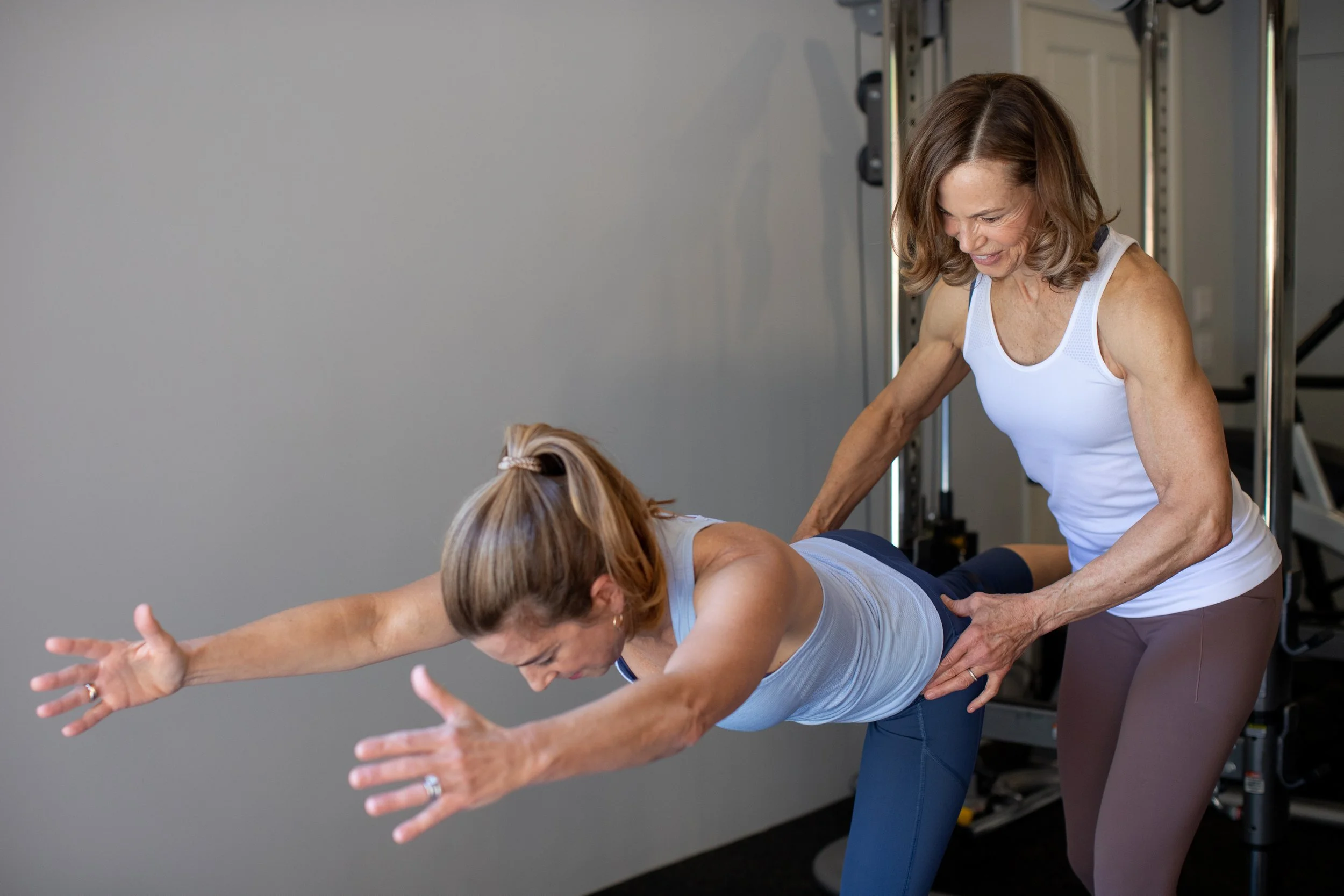
We relaxed the muscles at the front of the hip, restored mobility at the ankle and hip, and began activating and strengthening the muscles at the back of the hip so the hip flexors didn't have to do so much of the work. At home, she foam rolled, stretched gently, rested, did her daily posterior-hip exercises, and used heat while sitting to help the muscles relax.
Seven days later, she was pain-free.
Her hip was where she felt the pain, but the story was much bigger than her hip. Her ankle mobility, overworked calves, strength at the back of the hip, sudden increase in training intensity, and even what prompted her to push herself so hard were all pieces of the puzzle. Understanding what she needed meant looking beyond the place that hurt.
My questions are rarely limited to where it hurts. I want to know what her weeks have looked like, how she is sleeping, how much she sits, what exercise she is doing, whether she has traveled recently, what old injuries she has had, whether she strength trains, and what has changed in her life. I take those comments and begin weaving her history together, forming a story in my mind almost like a puzzle. I follow the muscles and tissues that cross the joint, what connects above and below it, where movement may have become restricted, and which muscles may not be contributing enough to support and stabilize the joint.
What causes musculoskeletal pain without an injury
A joint needs mobility, stability and strength. When one area doesn't move well, another area often finds a workaround. When a muscle isn't doing its share, something else picks up the slack. A body that hasn't had enough whole-body strength training may also lack some of the muscular support and control needed to manage the forces of everyday life.
Research on patellofemoral knee pain gives us a good example of why looking beyond the painful joint matters. A systematic review and meta-analysis found that strengthening both the hip and knee was more effective for reducing pain and improving activity than strengthening the knee alone.¹
Our bodies are clever compensators. They find another route and keep us going, sometimes for years. An upper back that has become stiff after years at a computer, for example, can change what the shoulder and neck have to do every time you reach overhead or turn your head. Eventually, one of these workarounds may become less efficient, and the area doing the extra work starts to complain.
Mobility is only one part of what I look at when someone is in pain. I am watching posture and balance, how she walks, how she controls movement, how her body manages force and whether she has enough strength throughout her body to support her joints. I want to know which muscles are working overtime, which aren't doing enough, and where the body has quietly been compensating.
How stress and emotions can affect musculoskeletal pain
Physical mechanics are only part of what I pay attention to. A woman doesn't leave the rest of her life outside the door when she comes in to exercise. She brings in the sleep she didn't get, the parent she is worried about, the hours she spent at her computer, the loss she is still trying to understand and the responsibilities waiting for her when she leaves.
Stress can show up physically in very ordinary ways. Breathing may become shallower, shoulders creep upward, the jaw tightens, sleep becomes less restorative and recovery suffers. Research has found associations between psychological factors such as distress, anxiety and fear and the development or persistence of musculoskeletal pain.² Pain itself is defined by the International Association for the Study of Pain as both a sensory and emotional experience, influenced to varying degrees by biological, psychological and social factors.³
For me, the mind and body are one. I don't see a clean dividing line where the physical person ends and the emotional person begins.
I would never tell someone that an unresolved emotion has simply turned itself into pain in her shoulder or back. We cannot make that connection so neatly, and pain is much more complex than that. I also don't believe our emotional experiences simply disappear because we haven't consciously understood or worked through them. What we haven't made sense of can still be part of our experience, even when we can't draw a straight line between it and a physical symptom.
Grief that never had much room to be grieved, years of caring for everyone else, fear about what comes next, a difficult relationship, a change in identity or even the complicated feelings that can accompany success may all be part of someone's story. I am not diagnosing those experiences as the cause of pain. I am interested in what was happening in her life when her body began responding differently.
I recognize this in myself. When I am at my computer managing work and feeling a great deal of responsibility for my team, I sometimes catch myself elevating one shoulder. I am not consciously telling my shoulder to do it. Suddenly, there I am with nerve pain, an old pattern I recognize quickly and want to address before it turns into a real problem for the days ahead. Once I noticed the connection, I became much more aware of the physical position I move into when I am carrying that sense of responsibility.
My shoulder isn't literally supporting my team, of course. What interests me is that my body has a recognizable physical response during those moments. Once I see it, I have something I can change.
Why musculoskeletal pain can become more common after 50
By our 50s, 60s and 70s, our bodies have accumulated decades of history. Old injuries, years of repeated movement, changes in joint mobility, long periods at a desk and too little strength training can all leave their fingerprints. Sleep and recovery can change, hormonal changes surrounding menopause can affect musculoskeletal health, and life itself may be asking more of us.
Aging parents, adult children, grandchildren, work, relationships, loss, retirement, businesses and changes in identity can arrive in combinations nobody prepared us for. All of this belongs to the same person. The mind and body aren't two separate departments.
How to notice your own pain patterns
An ache that keeps returning is worth observing before you automatically try to fix it. Notice what you were doing before it appeared, how long you had been sitting, whether your head is jutting forward, whether you are slumped to one side, how you slept, what exercise you did, and whether movement makes it better or worse. Look for the less obvious clues too. Are your shoulders creeping upward while you work? Is your jaw clenched while answering email? Does your neck become more uncomfortable during a demanding week?
My shoulder-at-the-computer discovery is exactly the kind of observation I mean. Instead of simply saying, "My shoulder hurts," I can say, "I noticed that when I am working at my computer and feeling a great deal of responsibility, I automatically elevate my shoulder and hold it there." I now have a behavior, a position and a circumstance I can work with rather than only a painful body part.
Your pattern may be entirely physical. You may notice no relationship between your discomfort and stress at all. The purpose isn't to prove that an emotion caused your pain or to diagnose yourself. It is to become a better observer of your own body and see what emerges.
How to know when your pain needs a doctor
New, sudden, severe, or unexplained pain deserves appropriate medical evaluation, particularly after a fall or injury, or if you're not sure if it's musculoskeletal pain. Significant swelling, redness or warmth, instability or repeated giving way, an inability to move or bear weight, persistent pins and needles or numbness, progressive weakness, fever, unexplained weight loss or symptoms that continue to worsen should be discussed with an appropriate medical professional. Sudden neurological symptoms or other severe symptoms may require urgent medical attention.
A known condition such as osteoarthritis, osteoporosis, an autoimmune disease or tissue injury also remains part of the picture. Looking at movement, stress, or the nervous system should never become a reason to ignore appropriate medical care.
I am not a physician or therapist, and I am careful about that boundary. My expertise is movement. Thirty years of doing this work has taught me that I understand movement better when I understand the person doing the moving.
How to start relieving musculoskeletal pain safely
Once anything medically concerning has been ruled out, I begin with the physical foundation. I look at the feet and ankles and work my way up, assessing mobility, posture, balance, alignment, breathing, stability and strength. I watch how the body manages force, where one area has been compensating for another, which muscles are working overtime and which ones need to wake up and join the party.
Whole-body strength is an important part of that foundation. Muscle helps support and control our joints and helps us absorb, transfer and respond to forces as we move. If a woman hasn't strength trained, I don't simply load the painful area and hope for the best. I want to prepare her entire body to handle progressively more load well.
A hip that moves and controls rotation better can change what is being asked of the knee. Better ankle mobility can change how the leg manages force. Improving upper-back and rib mobility can change what the shoulder and neck have to do. Strength, balance and postural control help the body use those improvements when real life asks something of it.
I want women to be strong enough to hike, carry their own luggage through an airport, lift a grandchild, catch themselves when they trip and get up from the floor with confidence. Strength matters enormously as we age, but I want to build it on a body that is prepared to use it.
Musculoskeletal pain can invite us to look beyond the place that hurts. What has my body been compensating for physically? Where do I need more mobility, stability or strength? What has been happening in my life? What patterns have I never noticed before?
That's what I did with the woman who came to me limping with hip pain. I didn't assume her hip was the whole problem. I looked at what had changed, how she was moving, what her body was suddenly being asked to do, and where she needed more mobility and strength. Her ankle, calves, hip muscles, sudden increase in hill climbing and even what prompted her to push herself so hard were all part of her story.
That is how I approach this work. I start with the person in front of me and follow the clues. Musculoskeletal pain may lead us to a muscle or joint, a tendon or other soft tissue, an old compensation, a lack of strength, a nervous system that hasn't had much recovery, an emotional experience that deserves attention, or several of those things woven together.
30 years of working with bodies has taught me not to rush past those clues. Finding the threads and following where they lead is often where the real work begins.
If you would like to experience how I begin the physical side of this work, my free Video Sampler walks you through five simple exercises with no equipment and gives you a feel for how I prepare the body for strength.
References
Nascimento LR, Teixeira-Salmela LF, Souza RB, Resende RA. Hip and Knee Strengthening Is More Effective Than Knee Strengthening Alone for Reducing Pain and Improving Activity in Individuals With Patellofemoral Pain: A Systematic Review With Meta-analysis. Journal of Orthopaedic & Sports Physical Therapy. 2018;48(1):19–31. doi:10.2519/jospt.2018.7365.
Martinez-Calderon J, Flores-Cortes M, Morales-Asencio JM, Luque-Suarez A. Which Psychological Factors Are Involved in the Onset and/or Persistence of Musculoskeletal Pain? An Umbrella Review of Systematic Reviews and Meta-Analyses of Prospective Cohort Studies. The Clinical Journal of Pain. 2020;36(8):626–637. doi:10.1097/AJP.0000000000000838.
Raja SN, Carr DB, Cohen M, et al. The revised International Association for the Study of Pain definition of pain: concepts, challenges, and compromises. Pain. 2020;161(9):1976–1982. doi:10.1097/j.pain.0000000000001939.
I'm interested in good health data too, but I don't want to spend the next twenty years watching for what might go wrong. Here is what my evenings look like, and why I think they matter more than the next test.