
Have you noticed what happens on the first warm weekend of spring? The trails fill up, the pickleball courts have a wait, the garden centers run out of potting soil by noon, and everyone seems to be trying to make up for the months they spent indoors. A few weeks later, plenty of us are dealing with a knee that complained after a long hike, a shoulder that did not appreciate an afternoon of pruning, or a back that tightened after the first round of golf. Whether winter where you live means snow and icy sidewalks or rain and short gray days, the pattern tends to be the same. Winter exercise is the part of the year almost nobody plans for, and yet it is the season that decides how spring and summer will feel in our bodies.
As the days grow shorter at the end of 2026 and the weather begins to change here in Northern California, I start thinking about how I want to approach my winter training. After months of hiking, cycling, weight training, and enjoying longer days outdoors, I welcome the opportunity to shift my focus.
Winter gives me time to go inward and address the little things that may have accumulated over the summer: tightness, restricted movement, or areas that need more attention. I spend more time working on joint mobility, stability, movement patterns, balance exercises, cardio that includes climbing stairs, Elliptical, and Peloton Zone 2 and 1-2 days of Interval training and progressive strength training, giving my body an opportunity to recover while preparing it for what's ahead.
Two things happen here:
I lift heavier to strengthen my muscles to prepare me for my spring activities that require strength and power,
build my aerobic base so I am prepared to build power when spring hits, and I work on resolving my body's little kinks that accumulated during my active summer through myofascial release, muscle activation, new movement patterns that my body is not familiar with, and tai chi.
I don't think of winter as a time to stop training. I think of it as a time to train with a different purpose.
I care about this because the way a woman over 50 spends her winter often shows up months later, on the trail or in the garden. Spring asks a lot of the body all at once. We go from shorter walks and more time on the couch to long hikes on uneven ground, kneeling in the garden for hours, lifting bags of soil and mulch, travel with heavy luggage, and sports we have not played since October. Those are wonderful things, and I want every woman reading this to do them. The challenge is that the body we bring into spring is the body we built, or did not build, over the winter. When the foundation is there, the season opens up. When it is not, the first big weekend can set someone back for weeks. So I want to offer a different way to think about the cold months. Pushing hard to chase a summer body in eight weeks is the wrong job for this season. The work that serves us now is restorative, the quiet, steady preparation that brings the body back into balance and gives it a solid base, so that when spring and summer arrive we are ready to say yes to them.
What Happens to Our Bodies Over The Winter
Most of us move less in winter, and the research backs up what we already sense. A systematic review looking across 26 studies from 18 countries found that people are generally more active in summer than in other seasons, and least active in winter.¹ The picture for older adults is more mixed in that review, and not everyone slows down the same way, but the overall pattern is fairly consistent. Shorter days, ice, rain, cold mornings, holidays and travel all chip away at the walks, the yard work and the errands on foot that keep us moving without our thinking about it. The formal workout often survives the winter better than the hundreds of small movements in a day, the stepping off curbs, the bending to pull weeds, the walking on grass and gravel that quietly keeps our ankles, hips and balance in practice.
As that everyday movement drops, the body adapts to what we are asking of it. More hours sitting at a desk, in the car or on the couch means the front of the hips spends long stretches in a shortened position, the upper back rounds forward toward a screen, and the muscles on the back of the body that help us climb, carry and stand tall are asked to do very little. Strength follows the same rule, and a meta-analysis pooling more than 100 studies on what happens when people stop resistance training found that every component of muscular strength dropped, that the losses grew the longer the break lasted, and that the effect was larger in people over 65.² In simple terms, our bodies hold on to strength less easily than they did at 30, and a long, still winter takes more from us than it used to. I share this to prepare you rather than to worry you, because these are exactly the months we can use on purpose.
Why Spring Is Hard On Knees, Hips & Shoulders
Here is what the jump from a quiet winter to a busy spring can look like in the body. Say your hips have spent the winter mostly sitting, and your ankles have spent it mostly walking on flat floors in supportive shoes. Then on the first sunny Saturday you head out for a three-hour hike with a long climb and a rocky descent. On the way down, the ankle cannot bend as far as the trail needs, so the knee moves forward and inward to make up the difference, the hip on that side drops, and the outer thigh and low back tighten to steady you. Every step repeats that pattern, and by the end of the day the knee is the one complaining, even though it was only doing extra work for an ankle and a hip that were not ready.
The garden works the same way. Kneeling for an hour asks the hips and knees for a range of motion they may not have used since fall. Lifting a bag of soil from the trunk of the car asks the legs and the deep muscles around the spine to share the load, and if the hips are stiff, the low back tends to round and take more of it. Reaching overhead to prune a tree asks the upper back to extend and rotate, and when it has spent the winter rounded over a laptop, the shoulder often works harder to compensate. Sometimes the body handles all of this well. Sometimes a knee, a shoulder or a back says otherwise. My goal is to have the body prepared for spring before spring arrives, so those demands feel like a good day out rather than two weeks of recovery.
What Winter Exercise Should Look Like After 50
The most useful winter exercise for women over 50 is restorative work, done steadily through the cold months, with strength added once the body is ready for it. Athletes have always understood this rhythm. After a competitive season, the off-season is when they address the small restrictions and imbalances the season left behind, rebuild their base, and prepare the body for the load that is coming. We can borrow that same rhythm, because our season is spring and summer. The order is the one I use with every woman I work with, starting with tissue quality, then the motion each joint needs, then the stability to control that motion, and only then strength. I walk through that sequence in detail in [Strength Training After 50: The Step Most Women Skip]([CHARMAIGNE: link to Blog 1]), so here I want to focus on what winter in particular asks of us, which is the ankles, hips and upper back that the season tends to stiffen.
Balance belongs at the center of this work, and balance exercises for women over 50 are some of the most underrated things we can practice in the winter months. Balance depends on the feet, the ankles, the hips, the core, the eyes and the inner ear all working together, and it gets better with practice at any age. A Cochrane systematic review, which pulls together the strongest available trials on a question, found that exercise programs built around balance and movements that support daily life reduced the rate of falls in older adults living in the community by about 24 percent.³ What this means for you is that standing on one leg, stepping in different directions and rising from a chair with control matter far more than they look, because those are the movements that keep us steady on a trail, on a wet sidewalk, or getting out of a car in a parking garage.
Where To Start This Winter
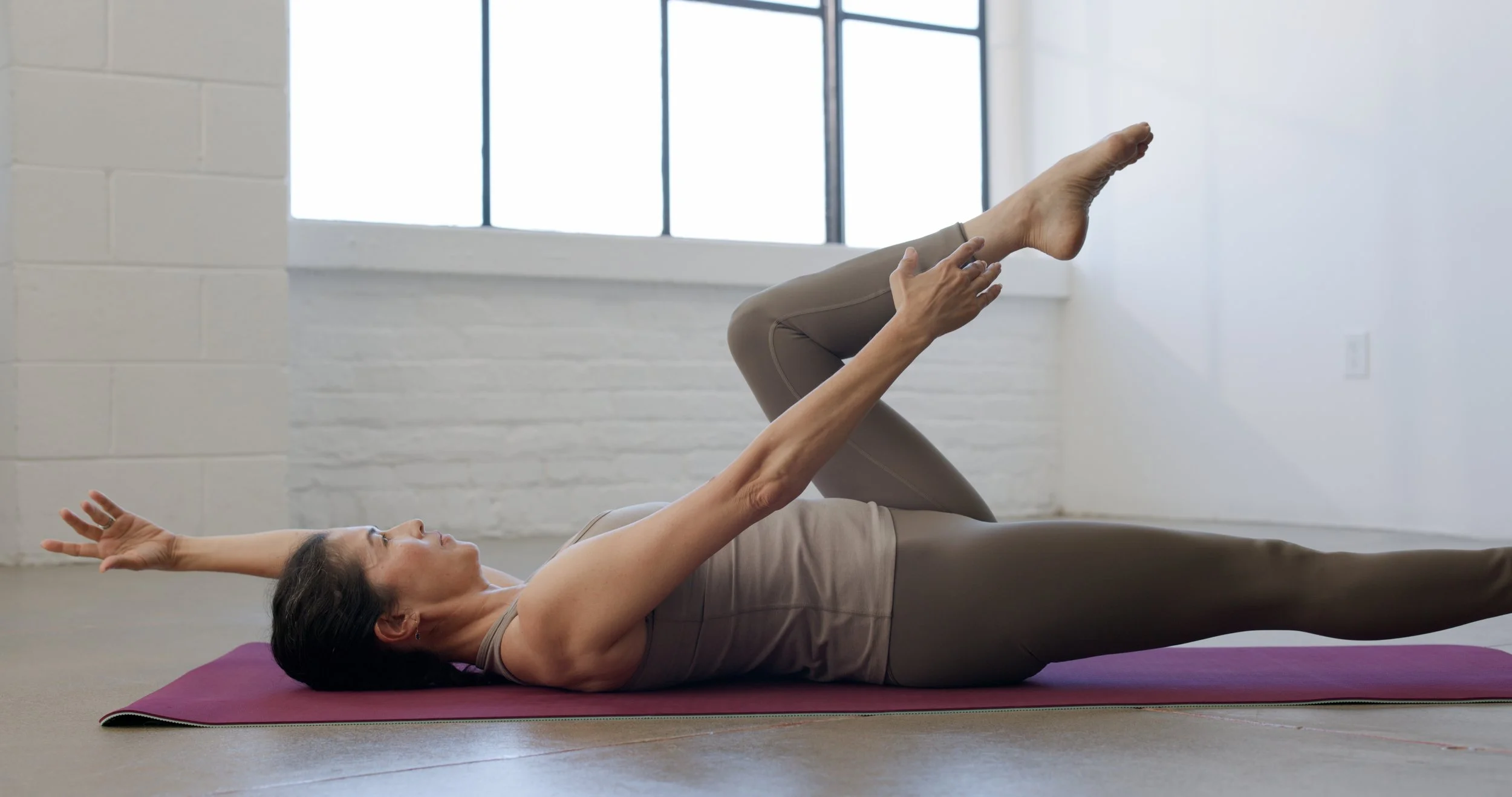
If you are wondering how to stay active in winter without a gym or a long list of workouts, this is where I would begin. I always start at the feet and work up, because the feet are where we meet the ground and everything above them responds to what they do. Simple foot and ankle work, such as rolling the arch on a small ball, writing the alphabet with your toes and ankles, and lifting the arch while standing, wakes up the area that spent the winter in shoes and on flat floors. From there we move up to the hips, with a variation of bridging exercises to bring the back of the body back into the work, clamshells to strengthen the side of the hip that keeps the knee tracking well, and gentle hip flexor stretches to undo some of the sitting. For the core, I like an ab brace and dead bugs, which teach the deep muscles to hold the spine steady while the arms and legs move, exactly what you need walking, or to lift a bag of soil or a suitcase without the low back taking over. The upper back gets gentle rotations and shoulder blade work, so that reaching overhead is shared between the shoulder and the spine instead of loaded onto one joint.
I recommend beginning with 15–20 minutes of focused foundational exercise, three to four times a week. You don't need to address every area of your body in every session. Start with the areas that need the most attention, and give yourself time to learn the movements and perform them well.
As your mobility, stability, and coordination improve, begin introducing more resistance and progressively challenging the muscles. For some women, that may happen within a few weeks; for others, particularly those managing injuries or longstanding movement restrictions, the process may take longer.
If you're already strength training, this work can complement your existing routine. If you're just getting started, it provides an opportunity to develop better movement control before gradually increasing the demands on your body.
The goal isn't to spend the entire winter doing gentle exercises. It's to use the season to build a stronger foundation, progressively increase your strength, and prepare your body for the activities you want to enjoy in spring.
What matters most here is consistency. Consistency is not sexy, but it is what gets results, and a modest amount of work done steadily through December, January and February will do more for you than an ambitious plan that lasts two weeks. Much of it happens quietly on the floor in your living room, which is exactly why it suits the season. The floor work also gives you a chance to slow down, breathe, and get to know where your body holds its tension. By the end of the winter, that attention gives you a much clearer sense of how your own body moves, and that knowledge goes with you into every hike and every workout that follows.
Where I Disagree With The January Reset
Every January the messages start, with 30-day challenges, new boot camps, promises to get you ready for summer in six weeks, and a wave of advice telling women to go all in from the first day of the year. I understand the appeal, because a fresh start feels good, and I would never discourage anyone from deciding to move more. Where I differ is in the intensity and the timing. Jumping from a quiet December into high-intensity classes or heavy lifting, on a body that has not been prepared, raises the chance that a knee, a shoulder or a back pushes back well before February. It also tends to create a cycle of starting hard, stopping, and starting again with something new, which teaches the mind to quit and does very little for the body. I would much rather you treat January as the beginning of a steady, restorative season than as a sprint.
There are real caveats here. If you have been strength training consistently and your movement feels sound, winter can be a perfectly good time to keep building strength, and you do not need to scale back to start over. Keep the restorative work alongside your training so it supports what you are already doing. For anyone with an acute pain right now, address that area first and check in with your doctor or physical therapist before you begin anything new, then come back to the foundation once it settles. Women who ski or snowshoe are already in their season, so for them this preparation belongs in the fall and continues alongside the sport.
Try This This Week
Before you change anything, take three simple measurements so you have something real to compare against in the spring. First, sit in a sturdy chair with your arms crossed over your chest and count how many times you can stand up fully and sit back down in 30 seconds, without using your hands. Second, while you brush your teeth, stand on one leg and time how long you can hold it on each side, up to 30 seconds, and note whether one side is steadier than the other. Third, if kneeling is comfortable for you, sit down on the floor and get back up without using your hands, or with as little help from them as you can, and notice which knee you lean toward and whether one side does more of the work.
Write your three results down with today's date and put them somewhere you will see them. Do the same three checks again at the beginning of March. Leave the judging aside and skip comparing your numbers with anyone else's. What you are after is a clear picture of where your body is starting from this winter, so you can see your own progress rather than guessing at it. One leg that is clearly weaker, or one side that is clearly less steady, is useful information, and it tells you where your restorative work should begin.
What Spring Feels Like After A Well-Spent Winter
The women I work with want to hike the hills behind their house without thinking about their knees, spend a full Saturday in the garden and still feel good on Sunday, carry luggage through an airport for a summer trip, lift a grandchild without bracing for it, and explore a new city on foot. That is what a well-spent winter gives us. With the foundation in place, spring can simply be a season of saying yes. This is the work I built my Signature Foundation Program around. The program takes you through the same restorative sequence I use with my one-on-one clients, starting at the feet and moving up through the knees, hips, low back and upper back and shoulders, so your body is balanced and prepared before you add load. If you would like a steady plan to follow this winter, you can find it here. Signature Foundation Program Winter is the quiet season, and it is a good one. What we give back to our bodies now is what carries us through the months we look forward to most.
References
Garriga A, Sempere-Rubio N, Molina-Prados MJ, Faubel R. Impact of Seasonality on Physical Activity: A Systematic Review. International Journal of Environmental Research and Public Health. 2022;19(1):2. doi:10.3390/ijerph19010002.
Bosquet L, Berryman N, Dupuy O, et al. Effect of training cessation on muscular performance: a meta-analysis. Scandinavian Journal of Medicine & Science in Sports. 2013;23(3):e140-e149. doi:10.1111/sms.12047.
Sherrington C, Fairhall NJ, Wallbank GK, et al. Exercise for preventing falls in older people living in the community. Cochrane Database of Systematic Reviews. 2019;1(1):CD012424. doi:10.1002/14651858.CD012424.pub2.
The way we spend the winter shows up months later, on the trail and in the garden. Here is how to use the quiet season to bring your body back into balance before spring asks a lot of it.